
Beyond the Hype: Why Your AI Strategy Should Start with a System Audit
Everyone is feeling the pressure to "do something with AI." But before rushing into new tools or building another app, business owners need to pause and ask the right questions. This post explains why adding AI to fragmented, 5-to-10-year-old systems is a recipe for chaos. Learn why a grounded system audit based on business fundamentals, not hype, is the critical first step to preparing your infrastructure for the AI era.
Sanjeev Narayan
1/5/20263 min read
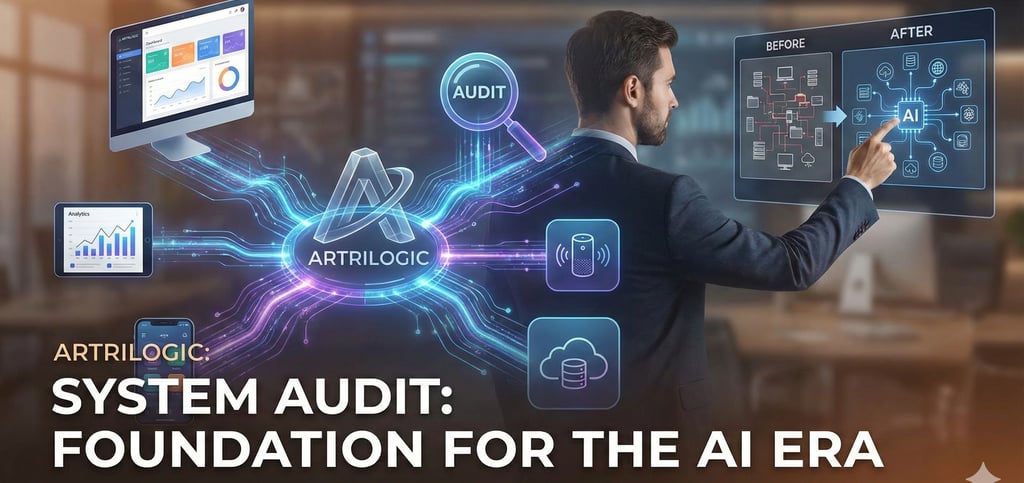

AI is at the forefront of business discussions. Most business owners ask, "How can we leverage AI with our current technology, and what are we missing?"
There is significant pressure to adopt AI. However, experience with past technology shifts shows that while technology evolves, core business fundamentals remain constant.
Before investing in new AI tools, it is important to have a practical discussion. This starts with a deceptively simple question.
What Problem Are You Actually Trying to Solve?
Recently, I spoke with a Rental Management Agency. They came to me with a specific request: "How can we build an app for our rental application review and selection process?"
At first, this seemed like a straightforward request. However, further discussion led us to ask, "How can we improve the rental application and review process?"
This shift in perspective is subtle but essential.
The first question assumes the answer is "an app."
The second question focuses on the outcome.
In a saturated app market, adding another app is not always the solution. The focus should be on achieving better outcomes. To serve your business effectively, it is important to examine its core purpose and how technology can support growth.
The Paradigm Shift: From Redundancy to Morphing
Many fear that AI will render existing systems obsolete. In practice, systems typically evolve rather than disappear.
Think about the history of the "Information Superhighway":
Mainframes: Provided power but required solid, stationary connections.
Desktops: Brought power to the desk but lacked mobility.
Web/Mobile: Revived the client-server model but added "anywhere" access.
In the AI era, channels such as web, mobile, and desktop are becoming delivery mechanisms, while the primary interface is increasingly conversational.
The Return of Voice
We’ve seen "Voice" try to take off before (think early smart speakers), but it was hampered by device constraints and rigid "command" logic. Today, AI has fixed the "brain" behind the voice. The next big shift isn't another app; it’s making your business reachable through any channel—including natural conversation.
The Silent Issue: "Too Many Apps"
In 2026, the primary challenge for business owners is not a lack of technology but system fragmentation.
Customers are experiencing app fatigue. They do not want to download large files, create new passwords, or verify additional emails to interact with your business. They expect a seamless, plug-and-play experience.
To prepare for this, your business needs to be either:
The Authority: The source of truth and data that others plug into.
The Super Consumer: A business that intelligently aggregates AI tools to resell an effortless outcome to the client.
The 5-to-10 Year System Review: An Audit Framework
If your core platforms are five or ten years old, they may not be outdated, but they could be closed systems. Leveraging AI requires an audit that extends beyond a basic checklist.
1. Data Accessibility (The Pipeline)
AI requires significant data access. If your data is isolated in legacy databases, an audit will determine where your source of truth resides and whether it can be integrated through APIs.
2. Workflow Mapping vs. "App Thinking."
We examine your end-to-end processes to identify manual handoffs and inefficiencies. AI performs best when workflows are clearly defined. If processes are undocumented, automation is not possible.
3. Channel Readiness
We assess whether your current system can support voice queries and manage interactions across web, chat, and mobile notifications. The goal is to ensure your systems can handle multiple channels, not just store records.
A Grounded Roadmap to Transformation
We do not advocate for complete system replacement. Instead, we support a gradual, evolutionary approach.
Phase 1: Audit (Weeks 1-3). We assess your current technical debt and identify immediate opportunities for automation.
Phase 2: Stabilization (Months 1-3). We improve data quality and ensure system interoperability, establishing a strong foundation.
Phase 3: AI Integration (Month 3+). Once the foundation is established, we implement AI solutions such as anticipatory data analysis, automated tenant screening, or voice-activated reporting.
The Bottom Line
The primary risk with AI is not automation replacing people, but falling behind competitors with more integrated and efficient systems.
A system review is not a delay; it is essential for sustainable progress. Avoid building apps solely for trends. Instead, develop systems that future-proof your core business.
Contact
Stabilise System and ready business for AI shift for small to medium businesses worldwide.
Services
Subscribe
info@artrilogic.com
© 2024. All rights reserved. | Privacy Policy
1300 401 672